Architecture Documentation That Doesn't Rot Six Months Later
Every architecture team has had some version of this conversation six months into an engagement: the diagram says the payment service talks to the old ledger, and production has been talking to the new one since March. Nobody lied. The diagram was accurate the day it was drawn. It became wrong the following week and stayed wrong for five months, because nothing in the way the team worked would have caught it, and nobody's job was to notice.
This is the normal life cycle of architecture documentation, not the exception. Ask any architect how much of what's on the shared drive or the wiki reflects the system as it actually runs today, and the honest answer is usually a number well under half, delivered with a shrug. The interesting question isn't why documentation rots — everyone already knows it does — it's why the standard responses to that fact keep failing, and what a team would have to change structurally, not just try harder at, to get a different result.
Why documentation rot isn't a discipline problem
The usual diagnosis is a people problem: architects are busy, deadlines are tight, and updating documentation is the kind of task that's easy to skip because nobody notices immediately when you skip it. That's true as far as it goes, but it treats documentation rot as a willpower failure — as if a sufficiently disciplined team would keep everything current through sheer conscientiousness. In practice, teams that are disciplined about almost everything else — code review, testing, incident retrospectives — still let documentation drift, which suggests the cause is structural, not moral.
It's a separate artifact from the system it describes
Most architecture documentation lives somewhere the system itself doesn't: a wiki page, a set of diagrams in a drawing tool, a PDF from the last governance review, a folder of PowerPoint slides someone built for a steering committee eighteen months ago. None of these live next to the code, the infrastructure config, or the deployment pipeline that actually constitutes the system. They're a description of the system, stored in a place with no mechanical connection to the thing being described.
That separation is the root of almost every other symptom. When the payment service starts calling the new ledger instead of the old one, that fact gets expressed in code, in a deployment, in a config change — and none of those artifacts have any relationship to the diagram that claims to represent them. The diagram doesn't know it's now wrong. Nothing does, until a human happens to open both at once and notices the mismatch, which might be during onboarding, during an audit, or during an incident at 2 a.m. — none of which are situations where "go update the wiki" is anyone's next move.
It's maintained by a different process on a different cadence
Code changes on the cadence of the engineering team: commits, pull requests, deploys, several times a day on an active system. Documentation changes on the cadence of whoever remembers, has time, and cares enough — which in most organizations means quarterly at best, and realistically closer to "whenever there's an audit, a new hire, or a governance review coming up." Two processes running on two different clocks will drift apart by construction, not by accident. It doesn't matter how good either process is in isolation; if they're not synchronized, the gap between them grows monotonically until something forces a reconciliation.
This is the same failure mode that database people have understood for decades as the two-writers problem: if two systems both hold a copy of the same fact and there's no mechanism forcing them to update together, they will diverge, and the only question is how long it takes and how bad the divergence gets before someone notices. Architecture documentation and the system it describes are exactly two such systems, and in most organizations there is no mechanism at all — just an expectation, unenforced, that someone will remember.
Updating it is always the first thing cut under pressure
Even where a mechanism nominally exists — a ticket to "update the architecture diagram" filed alongside the change ticket — it's the first casualty of a tight deadline, and for a locally rational reason: skipping it has no visible, immediate cost. Skipping a test might mean a broken build. Skipping a security review might mean a blocked release. Skipping the documentation update means... nothing happens. The system still works. The deploy still goes out. The cost lands later, distributed across every future person who trusts a diagram that's quietly wrong, and by the time that cost is visible, it can't be traced back to the specific deadline that caused it. Under deadline pressure, a cost that's invisible now and diffuse later loses every time to a cost that's visible now and immediate.
What doesn't fix it
Before getting to what works, it's worth naming what reliably doesn't, because most organizations have already tried it. "We'll do a documentation sprint" fixes the backlog once and starts rotting again the next day, because it doesn't change the underlying process — it just pays down the debt without addressing why the debt accumulated. "We'll add a documentation review to the Definition of Done" helps only as long as someone is actually checking it, and the moment review pressure eases, it becomes a checkbox people learn to tick without doing the work behind it. "We'll appoint a documentation owner" concentrates the job in one person who cannot possibly track every change made by every team, and who becomes a bottleneck the moment they go on leave.
All three share the same flaw: they add process on top of a structure that still keeps documentation as a separate artifact, updated out of band, on a different cadence, by different incentives than the system change itself. They ask people to be more disciplined inside a structure engineered to make the discipline hard to sustain. The fix has to change the structure, not the discipline layered on top of it.
Four practices that actually hold up
None of these are exotic. Individually, most architecture teams already do some version of at least one. The difference is treating all four as the actual mechanism, not as aspirational best practice sitting next to a governance policy nobody follows.
1. Attach documentation to the model element, not beside it
The single highest-leverage change is also the simplest to state: a description, an owner, a status, a set of tagged properties should live as attributes on the element itself — the application, the service, the interface — not in a separate document that merely refers to that element by name. This is the difference between a property on a database row and a paragraph in a Word document that happens to mention the row's primary key.
The practical effect is that there is no longer a second place for the description to be. If the payment service's description says it talks to the old ledger, and someone opens the payment service element to add a new relationship, the stale description is sitting right there, attached to the exact object they're editing — not eighteen clicks away in a wiki they'd have to remember exists and think to check. In Mooodels this is a direct consequence of treating architecture as a semantic model rather than a picture: elements, relationships, views, and properties all live in the same canonical model, addressed by stable IDs, so a description or an owner tag isn't an external annotation about an element — it's part of the element's own record. There's no synchronization step between "the model" and "the documentation" because they were never two things.
This doesn't eliminate the need to remember to write the description in the first place. What it removes is the second failure mode — writing an accurate description once, then having it live somewhere disconnected enough that nobody thinks to revisit it when the thing it describes changes.
2. Generate views on demand instead of hand-maintaining static diagrams
A hand-drawn diagram is a snapshot with no expiry date printed on it. Someone draws the application landscape for a steering committee in January; by June it's still sitting in the same folder, still looking exactly as authoritative as it did the day it was made, with nothing about its appearance signaling that eleven applications have since been added, retired, or renamed. The diagram doesn't announce its own obsolescence — it just sits there, indistinguishable at a glance from a diagram drawn yesterday.
The fix isn't to draw diagrams more often. It's to stop treating a diagram as a thing that gets drawn once and stop generating it as a query against current model state instead. If a view is a live selection over the model — every application in a domain, everything within two hops of a given service, every integration crossing a security boundary — then asking for that view a second time doesn't require finding and updating an old file. It requires running the same query again, against whatever the model currently says, which is by definition current. The diagram stops being an artifact with its own lifecycle to maintain and becomes closer to a report: cheap to regenerate, worthless to hoard.
3. Make "update the model" part of the same change, not a follow-up ticket
This is the practice that actually closes the cadence gap described earlier. If updating the model is a separate ticket, it inherits everything that makes separate tickets fail: it can be reprioritized, reassigned, forgotten, or closed as "won't do" under deadline pressure without blocking anything. If updating the model is part of the same pull request as the system change — the same diff, the same review, the same merge gate — it inherits the properties of that process instead: it gets reviewed by someone whose job is to check exactly this kind of thing, and it either goes in with the change or the change doesn't go in.
Concretely, this means a model diff sitting next to a code diff in the same review, kept in Git alongside the code it describes rather than in a wiki with its own access model and its own history. A reviewer looking at a pull request that adds a new dependency from the payment service to a new ledger can see, in the same review, whether the model has been updated to reflect that dependency — the same way they'd notice a missing test. This is also where an AI assistant earns its keep without being trusted to edit anything unsupervised: asked to describe a code change against the current model, it can propose the corresponding model update as a reviewable patch — a set of proposed additions, renames, or relationship changes a human approves or rejects — rather than silently writing to the model itself. The proposal still has to be checked by a person who knows what actually changed; what the assistant removes is the blank-page problem of drafting the model update from scratch.
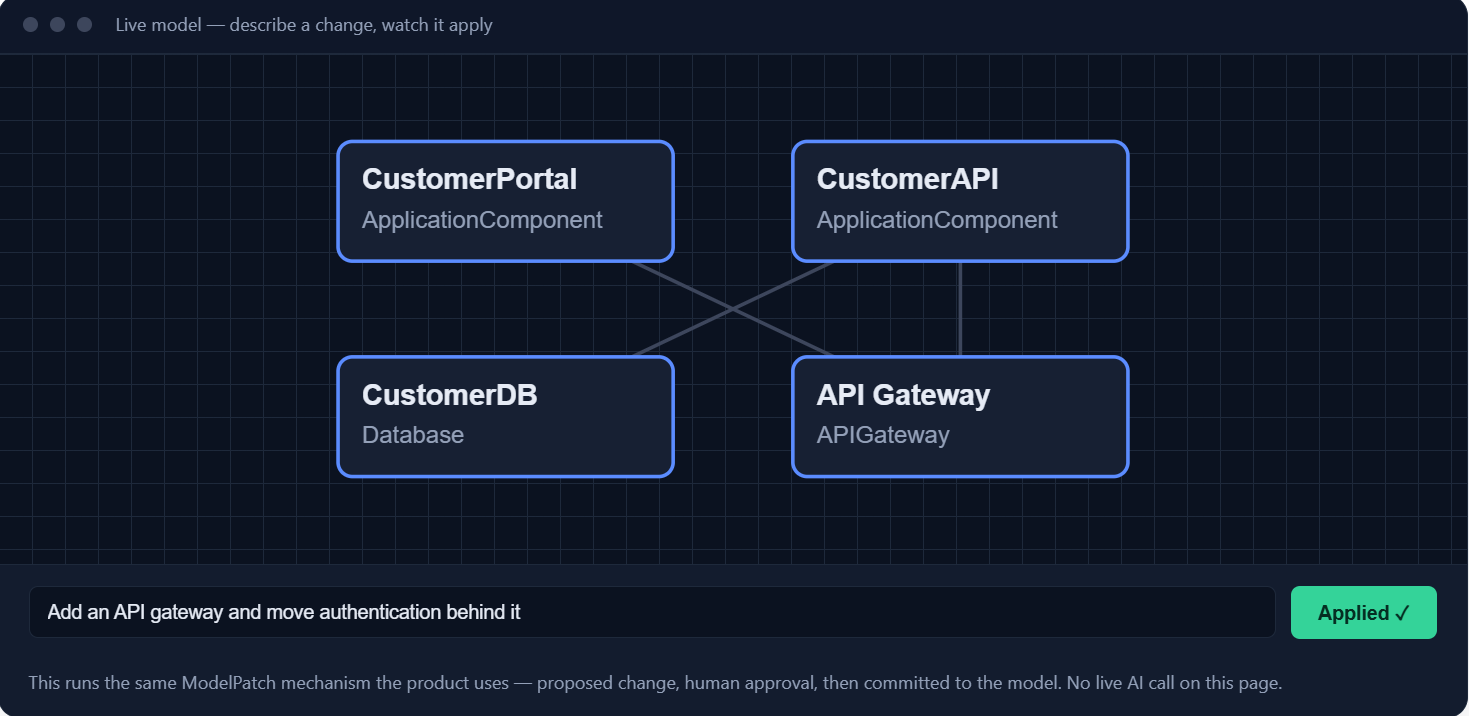
The mechanical trick here is unglamorous but does the real work: put the model update in the path of something that already has to happen anyway. A pull request already has to be reviewed and merged for the system change to ship. Riding on that existing gate costs far less discipline than creating a new one and hoping people remember to use it.
4. Lint for missing descriptions and owners, the same way you'd catch a missing test
Code review catches a missing test because someone — a person or, increasingly, an automated check — is specifically looking for it, and a pull request without one either doesn't merge or gets flagged. Nothing equivalent exists for documentation in most architecture practices: there's no automated check that says "this new service has no description and no assigned owner," so it merges silently, and the gap never gets any more visible than it was the moment it was created.
Deterministic rules run against the model close exactly this gap, because at that point there's a real, addressable object to run a rule against — an element with a description field, an owner property, a status tag — rather than a picture with no structure a rule engine could query. A small set of governance rules can flag, automatically and exhaustively, every element missing a description, every Tier-1 application with no assigned owner, every public-facing service that hasn't been reviewed in the last quarter. Run as part of the same review gate as the model diff itself, this turns "documentation is incomplete" from a fact someone might notice during an audit into a fact that blocks a merge, the same day the gap was introduced.
rule: element-must-have-owner
  applies_to: Application, Service
  where: tag("tier") == "1"
  require: property("owner") is not empty
  severity: blocking

rule: element-must-have-description
  applies_to: Application, Service, Interface
  require: description is not empty and length(description) > 20
  severity: warning
The specific rules matter less than the mechanism: a check that runs every time, on every change, without needing anyone to remember to run it manually. That's the property that makes it durable in a way a documentation checklist in a wiki never is — a checklist only works if someone chooses to consult it, and a rule engine doesn't need to be consulted, it just runs.
| Failure mode | Old response | Structural fix |
|---|---|---|
| Description lives in a doc, drifts from the system | Ask people to update the wiki | Description is a property on the element itself |
| Diagram drawn once, never refreshed | Schedule periodic diagram reviews | Views generated on demand from current model state |
| Model update deprioritized under deadline pressure | File a follow-up ticket | Model diff rides in the same PR as the code diff |
| Missing owner or description goes unnoticed | Catch it at the next audit | Automated rule blocks or flags it at merge time |
A worked example
Take the ledger migration from the opening: the payment service is being repointed from an old ledger system to a new one. Under the old process, an engineer changes the integration code, tests it, ships it. Someone, at some point, is supposed to remember that a diagram somewhere shows the old dependency and go fix it — and in practice, six months later, nobody has, because there was never a moment where skipping that step visibly cost anything.
Under the four practices above, the same change looks different in a few concrete ways. The relationship between the payment service and the ledger is a property of the model, not a fact duplicated in a drawing — so "update the diagram" isn't a separate task, it's editing the same relationship the code change is really about. The pull request that changes the integration code carries a model diff alongside it: the old relationship removed, the new one added, in the same review. A lint rule checking that every external integration has a description catches it immediately if the new relationship goes in without one — the same way a missing test would get flagged. And any view of the payment service's dependencies, generated on demand, reflects the new ledger the moment the change merges, because the view was never a separate drawing to forget about — it's a query that runs against whatever the model currently says.
None of this required anyone to be more careful. It required the model update to be in the path of a gate that already existed — code review — rather than sitting off to the side as a task with no gate behind it at all.
What this doesn't solve, and why that's worth saying plainly
None of this makes documentation self-maintaining, and it's worth being direct about that rather than implying otherwise. No tool — Mooodels included — can look at a code change and know, unprompted, that the description of a business capability is now subtly wrong because the capability's scope shifted, or that an owner listed in the model left the team last month and nobody's told the system. A rule can catch a missing description. It cannot catch a description that's present, plausible-sounding, and quietly false. Accuracy is still a human judgment call, made by someone who understands what actually changed — no rule engine and no AI assistant can substitute for that judgment, only reduce how often the judgment gets skipped entirely.
What these four practices change is the cost of doing the right thing, not the existence of a right thing to do. Attaching documentation to the model instead of a separate file removes a synchronization step, not the need to write the description in the first place. Generating views on demand removes the burden of manually refreshing a diagram, not the judgment of deciding what a view should show. Bundling the model update into the same change removes the excuse that documentation is a separate task with its own priority queue, not the requirement that someone actually make the update correct. Linting for missing fields catches absence, not inaccuracy — a populated but stale description still passes every automated check that only looks for whether a field exists.
The honest way to describe the goal is friction reduction, not automation of judgment. A team that has to remember to open a wiki, find the right page, edit prose, and publish it separately from shipping the actual change will skip that step under enough pressure, reliably, because the cost of skipping it is invisible and the cost of doing it is not. A team where the same update is a few fields on an object they're already editing, inside a review gate that already has to pass, will keep doing it under the same pressure — not because they've become more disciplined, but because the discipline now costs almost nothing extra. Sustainable practices are the ones cheap enough to survive a deadline. Everything else is a policy that works until the first time it's inconvenient, which for most teams is also the first real test it faces.
What to check in your own process
A short, honest audit surfaces most of this without needing a new tool at all. Does a description or an owner live as a property on the thing it describes, or in a document that merely refers to it by name? When a diagram gets shown to a stakeholder, is it freshly generated from current state, or is it a file someone remembers to open from a folder? When a system change ships, does anything about the review process touch the model, or is "update the docs" a ticket that competes for priority against everything else in the backlog? And if an element has no owner or no description, does anything actually flag that before the change merges, or only whenever the next audit happens to look?
A team that answers all four in the structural direction — attached, generated, bundled, linted — has a documentation process built to survive deadline pressure rather than one that depends on nobody ever being under deadline pressure, which in most organizations is never. That's the whole difference. Not a smarter diagram, not a stricter policy — a process where staying current costs less than letting it rot, so that on the day something has to give, documentation isn't automatically the thing that gives.
See the model this article describes, working in a real editor.
Try the live demo