Why AI Shouldn't Edit Your Architecture Model Directly
Every few months, someone asks a version of the same question: now that the models are so much better, why not just let the AI edit the architecture directly? Skip the intermediate step. Let it add the element, wire the relationship, and be done. The question usually comes from a good place — the proposal-and-approval flow does add friction, and friction is the thing product people are trained to hunt down and remove. But this is one of the places where the friction is the point, not a bug waiting to be optimized away. It's worth explaining exactly why, because "trust it more once it's better" is a plausible-sounding argument that turns out to be wrong for reasons that have nothing to do with how good the AI is.
The argument that sounds right and isn't
The case for direct mutation usually goes like this: an AI assistant that can already draft a working relationship, name a component sensibly, and reason about a metamodel is clearly capable enough to just make the change. Adding a review step on top of that capability is treating a competent assistant like a junior intern who needs every keystroke checked. As the models improve — and they keep improving — the argument gets more persuasive, not less. Today's near-miss becomes next year's clean hit, so why hard-code a permanent tax on every single change for a problem that's shrinking on its own?
The flaw isn't in the premise about capability. It's in the conclusion about what capability buys you. Getting better at proposing the right change and being safe to trust with direct, unreviewed mutation are not the same skill, and they don't converge just because the first one keeps improving. One is a question about output quality. The other is a question about what happens systemically when that output is wrong — and wrong is not a probability that model improvement drives to zero. It's a probability that gets smaller and a consequence that, without a structural backstop, stays exactly as large as it always was. A rare failure with a large blast radius is still worth designing against, arguably more so once it's rare enough that nobody's watching for it anymore.
Hallucination doesn't go away, it goes quiet
Start with the failure mode everyone already knows about: the AI states something confidently that isn't true. In a chat window, a hallucination is annoying but contained. The assistant claims a library has a method it doesn't have, or misremembers a date, and the human reading the response either already knows better or checks before acting on it. The cost of the mistake is bounded by how much a person trusted a sentence.
Now put that same failure mode inside a system that has structured types, valid relationship kinds, and a metamodel with real constraints — an ArchiMate profile, say, where an Application Component can realize a Application Service but can't directly serve a Business Actor without an intervening layer, or a C4 profile where a Container has to sit inside a System. An AI editing a model directly is not writing a sentence. It's proposing a typed operation: create this element, of this type, with this relationship, to that other element. A hallucination in this context doesn't look like a wrong fact in prose. It looks like a plausible-sounding element type that doesn't exist in the profile, a relationship between two element kinds the metamodel doesn't permit, or a reference to an element ID that was renamed three revisions ago and no longer resolves to anything. The model doesn't reject this the way a compiler rejects broken syntax — nothing about a graph of nodes and edges is inherently self-checking. Without something in front of the write path whose entire job is to catch exactly this, the fabricated type or the invalid relationship just becomes part of the model. It has the same standing as everything a human ever added by hand.
This is the part that doesn't improve linearly with model capability. A better model hallucinates less often — that's real and worth having. But "less often" is not "never," and the entire risk calculus for a system of record is built around what happens on the occasions it's wrong, not around the average case. A spellchecker that catches ninety-nine percent of typos is a good spellchecker. A validation layer that catches ninety-nine percent of invalid model mutations and lets the other one percent write silently into a canonical architecture model is not a good validation layer, because that one percent doesn't announce itself. It just sits there, indistinguishable from a legitimate edit, until someone downstream builds on it.
A model has dependents; a chat response doesn't
This is the part of the argument that's easy to underweight because it has nothing to do with AI at all — it's about what kind of object a model is. A chat response is, structurally, a leaf. Nothing else in the system reads it, parses it, or builds derived output from it. If it's wrong, the blast radius is exactly as large as the number of people who read that one reply and didn't check it.
An architecture model is not a leaf. It's closer to a root. Other views are queries over it. Export pipelines read it to produce Archi or Sparx EA-compatible output for a client or a regulator. Governance rules run against it continuously, checking that every Tier-1 application has an owner or that nothing public-facing bypasses the approved gateway. Impact analysis — what breaks if we retire this system — is a graph traversal over exactly this data. Dashboards, reports, and audit exports are all downstream of the same canonical structure. A single corrupted element or a relationship that shouldn't exist doesn't stay contained to the place it was introduced. It propagates to every view that includes that element, every rule evaluation that touches it, and every export generated after the fact — and it does so silently, because nothing about a downstream view knows to distinguish a legitimately modelled fact from a fabricated one. They're stored the same way.
Contrast the two failure modes side by side. A wrong chat answer costs one person one bad decision, and it's usually visible immediately — the sentence reads oddly, or contradicts something the reader already knows, and gets ignored. A silently corrupted architecture model costs an unknown number of people an unknown number of bad decisions, spread out over however long it takes someone to notice, and by construction it's the decisions built on top of the corruption that are hardest to trace back to it. Nobody double-checks a relationship that's been sitting in the model for four months and has already been cited in two governance reports. That's exactly the property that makes silent corruption in a system of record categorically worse than a wrong answer in a conversation — not worse in degree, worse in kind, because the two failures don't scale the same way with time.
What audit and reversibility actually require
Regulated environments — and most of Mooodels' public-sector context falls into this bucket — don't ask "is the AI usually right." They ask a narrower and more useful question: for any given fact in the model, can you show who or what asserted it, when, on what basis, and what the model looked like immediately before and after. That's not a preference about AI specifically. It's the same standard applied to every other kind of change to a system of record, and it predates AI assistance by decades. A financial ledger, a clinical record, a legal case file — all of them are built around the same expectation, because "trust us, it's probably fine" has never been an acceptable audit answer for anything that other decisions get built on top of.
A model an AI can write into directly fails that standard structurally, not because any particular AI is untrustworthy, but because direct mutation collapses proposal and commitment into a single, unreviewed event. There's no point at which a human looked at the specific change and said yes. There's no record distinguishing "an architect decided this" from "an assistant inferred this from an ambiguous instruction and nobody caught it." And critically, there's no clean undo — reverting a direct AI edit means diffing the model against some earlier snapshot and hoping the diff is legible, rather than simply declining to commit a specific, already-isolated patch.
A structured proposal fixes this by construction, because the reviewable unit already exists before anything touches the model. The patch itself — not a snapshot before-and-after, not a reconstructed diff — is the audit record. It names an actor, a timestamp, an instruction, and a bounded set of typed operations. Approving it is a discrete, attributable event. Rejecting it costs nothing, because nothing was ever written. This is a mechanical property of the workflow, not a claim about how careful anyone using it happens to be — which matters, because it means the audit trail exists whether or not any individual review was thorough, which is exactly the property regulated environments are checking for.
The alternative, concretely
The flow Mooodels enforces is deliberately boring, in the way that good infrastructure is usually boring:
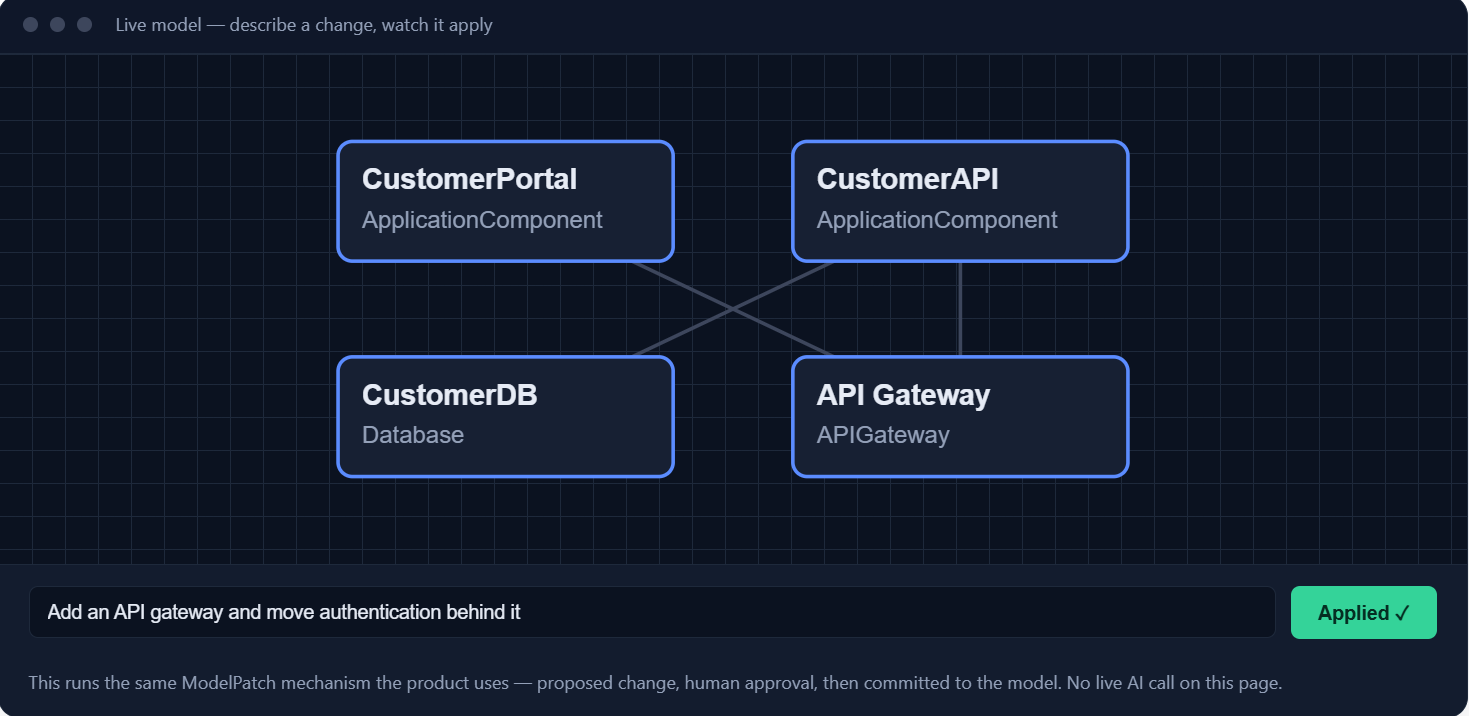
- A user gives an instruction in plain language — "add an API gateway in front of the payment service" — inside a specific model context, not a blank page.
- The AI receives that instruction along with the relevant slice of the current model: the elements and relationships near what's being asked about, not the entire portfolio.
- It returns a ModelPatch — a structured, typed set of operations, not free text and not a direct write.
- The patch runs through schema validation, checking that it's structurally well-formed.
- It runs through metamodel validation, checking that every element type and relationship is legal under whichever profile is active — Generic, ArchiMate, C4, or a custom one.
- It runs through the model's own architecture rules — the deterministic checks that would apply to a human-made edit too, like ownership requirements or approved-gateway constraints.
- A human-readable preview renders what the patch would actually do, in the same visual and semantic terms as any other change to the model.
- A human approves, rejects, or edits it.
- Only an approved patch is committed to the canonical model, at which point it becomes indistinguishable from any other properly recorded change.
Notice what each stage is actually for, because they're not redundant with each other. Schema validation catches malformed structure — a patch that isn't even shaped like a valid operation. Metamodel validation catches type and relationship violations specific to whichever profile is active — the fabricated element type, the illegal connection between two kinds of elements the active profile forbids. Architecture rule checks catch violations of rules specific to this organization's model — a public-facing application that bypasses the approved gateway, a Tier-1 system with no assigned owner. None of these three would be caught by either of the other two; they're independent nets, not the same check run three times.
What a ModelPatch actually looks like, stripped down, is deliberately unglamorous:
{
  "patchId": "p_9f21c4",
  "instruction": "Add an API gateway in front of the payment service",
  "operations": [
    {
      "op": "add",
      "type": "ApplicationComponent",
      "id": "tmp_gw_01",
      "name": "Payment API Gateway",
      "properties": { "layer": "integration" }
    },
    {
      "op": "connect",
      "relationship": "Serving",
      "source": "tmp_gw_01",
      "target": "elem_payment_svc_4471"
    },
    {
      "op": "disconnect",
      "relationship": "Serving",
      "source": "elem_public_client_09",
      "target": "elem_payment_svc_4471",
      "reason": "replaced by routed path through gateway"
    }
  ],
  "status": "pending_review"
}
Nothing in that object has touched the model yet. It's inert data — inspectable, diffable, and rejectable without consequence — right up until a human approves it and the commit step runs. That's the entire mechanism. It isn't exotic; it's the same shape as a pull request, applied to an architecture model instead of a codebase, for the same underlying reason: changes to something other people depend on go through a proposal stage before they go through a commit stage, and the two stages are not allowed to collapse into one, no matter how good the author of the proposal is.
The honest cost: this doesn't stay free
It would be dishonest to present the propose-validate-review-commit loop as a solved problem with no downside, because it isn't. The real cost is review fatigue, and it's worth naming plainly rather than glossing over.
The whole mechanism depends on a human actually reading the preview before clicking approve. The first ten patches, most reviewers read carefully — the change is new, the stakes feel real, the habit of scrutiny hasn't formed yet. By the hundredth patch, especially if the first ninety-nine were all correct, the temptation to approve on reflex is not hypothetical. It's the same failure mode that shows up in code review when a trusted contributor's pull requests stop getting read closely, or in any workflow where a gate that's right often enough starts being treated as though it's right always. A human rubber-stamping every proposal without genuinely reading it produces exactly the same outcome as direct mutation would have — a change enters the model without anyone having actually verified it — except now it also carries a false signal of having been reviewed, which is arguably worse than no review at all, because it's a false signal that suppresses future scrutiny too.
This isn't a problem Mooodels claims to have solved, and anyone who tells you their review workflow has fully solved it is selling something. What can be said honestly is narrower: a reviewable, revertible proposal is strictly better than no review step at all, because it at least makes rigorous review possible and creates a real record of who approved what, even on the days review is shallow. It doesn't make review rigorous by construction, and no UI can force a tired human at the end of a long day to read a diff carefully rather than skim it. The mitigations that help — batching related operations into one coherent patch instead of a dozen fragments so there's less to skim past, surfacing the specific rule or relationship a patch touches rather than a wall of raw JSON, keeping the blast radius of any single patch small enough that a shallow read still catches the obviously wrong ones, routing higher-risk patch types to a second reviewer — are real, worth building, and still fundamentally about managing a human attention problem, not eliminating it. Anyone promising a review workflow that stays sharp forever without that ongoing maintenance is not describing how attention actually works.
What better AI actually changes, and what it doesn't
It's worth being precise about which parts of this problem model improvement genuinely helps with, because it's not none of them. A more capable AI proposes better patches on average — fewer nonsensical relationships, better-scoped changes, clearer instructions translated into cleaner operations. That reduces how often a human has to reject or edit a proposal, and it's a real, welcome improvement. Nobody should want a deliberately worse assistant on the theory that friction alone is good discipline.
What model improvement doesn't change is the shape of the risk on the occasions it's wrong, and it doesn't touch the review-fatigue problem at all — if anything, a more reliable AI makes rubber-stamping more likely, not less, because reviewers calibrate their scrutiny to their prior experience of being burned. A near-perfect assistant is, perversely, the condition under which the human gate is most likely to erode into a formality, which is exactly why the gate needs to keep being a real gate on its own terms rather than something that's allowed to become vestigial once the thing behind it seems trustworthy enough. The two problems — is the proposal usually right, and does the system stay safe on the times it isn't — don't share a single fix, and conflating them is how "the model got better" quietly turns into "we stopped checking."
Where this leaves the design decision
None of this is an argument against AI assistance in architecture work — the opposite, really. An AI that can read a real model, understand what's near the thing being changed, and propose a well-formed, typed patch is doing something genuinely useful that a search box or a static diagram tool can't. The argument is narrower and more specific: that usefulness is compatible with never handing the AI direct write access to a canonical model that other systems, other views, and other people's decisions depend on. Proposing is not the same privilege as committing, and there's no capability threshold where that stops being true — a smarter model deserves a better-designed review experience, not a shorter one.
The version of this that ages well isn't "AI writes directly once it's reliable enough." It's a validation and review layer that gets easier to pass legitimately as the AI improves — fewer rejected patches, faster approvals, less back-and-forth — while staying exactly as strict about what it's willing to let through without a human decision. Mooodels is built on the bet that this is the version worth building, and that the honest, unglamorous parts of it — the schema check, the metamodel check, the rule engine, the plain fact that a rejected patch costs nothing because nothing was ever written, and the ongoing work of keeping human reviewers actually paying attention — are the parts that make the rest of the system trustworthy enough to build a model-native architecture practice on top of.
See the model this article describes, working in a real editor.
Try the live demo